One afternoon, on a visit to his family, he had summoned up the courage to tell his father that he didn't want to become a priest. That he wanted to travel.
It’s absolutely true that
if Joe Cortez had called the fight off after the third knock down, nobody would
have criticized him and the idea that we would have the subsequent fight
between these two great fighters would be far-fetched. Probably we wouldn’t
have had Paquiao-Marquez two, three, and now four. But life is funny and so
many things that happened in sports could go either way at a given time.
Three bouts, 36 rounds,
108 minutes of fighting have left these two men very much still in dispute. And
in a cord on just one matter. Another meeting in the ring was required to
settle the tale of Pacquiao and Marquez. A fourth collision is the only solution
that remain.
Matheos Viktor Messakh, The Jakarta Post, Karawaci | Mon, 03/28/2011 1:50 AM
Surprise, surprise: Indonesian Rory Hie reacts during the final round of the Indonesia PGA Championship at Imperial Klub Golf in Karawaci, Tangerang, on Sunday. [Courtesy of OneAsia]
Australian Andre Stolz, who came out of retirement two years ago, recorded an emotional triumph in the Indonesia PGA Championship at Imperial Klub Golf at Karawaci on Sunday.
Indonesian Rory Hie carded a 72 to finish alone in second place one shot behind Stolz.
The 40-year-old Stolz fired a final round four-under-par 68 for a winning total of 14-under-par 274 to win US$180,000 in prize money while overnight leader Rory pocketed US$102,000, in his biggest take ever.
Rory, playing in the final pairing behind Stolz, birdied the last two holes and lost his chance of winning after bogeying the 10th, double bogeying the 11th and bogeying the 12th.
“I really thought this was going to be my week. I prepared so hard. I am proud of the way I finished the round and this final day has been a great learning experience,” said Rory, who claimed the International Championship at the Imperial in 2008 on the ASEAN PGA Tour just months after turning pro.
“It’s bittersweet. I gave my best to win but I think that’s all I have. It’s not my biggest win but it is the biggest check I have ever had,” Rory said.
“I’m very thankful for what my dad has done for me since I was young. I owe everything to my dad,” Rory said, referring to his father and caddy, Tommy Hie.
Rory played for the University of Southern California and at one point was ranked the sixth best amateur in the world, leaving after two years to turn pro.
Culture Tourism Minister Jero Wacik hailed Rory as a future golf champion.
“We are proud that the Indonesia PGA Championship has been a success and we are also proud that we had a player that finished as a runner-up. He is just 23-years-old so there is still a lot of time to go. This is just a delayed victory for him,” Jero said.
“Over the last three days, TV coverage has always mentioned Indonesia because Rory was among the leaders. This rarely happens at any international golf championship — and this one was under PGA sanction.”
“President Susilo Bambang Yudhoyono, when he heard that Rory was the leader [Saturday], expected that Rory would finished in at least the top 10 [Sunday], but fantastically this young man finished second,” Jero said.
Sweet come back: Australian Andre Stolz and his wife, who caddied for him, enjoy a celebratory embrace after the final round of the Indonesia PGA Championship at Imperial Klub Golf in Karawaci, Tangerang, on Sunday. [Courtesy of OneAsia]
Stolz was one of his country’s finest players before a wrist problem had a profound effect on his career
He won titles at the US PGA Tour, the Nationwide Tour and the Japan Tour plus tasted victory four times on the PGA Tour of Australasia.
However, in 2005 a nagging wrist injury caused by wear and tear forced him into retirement for nearly three years. He gradually started to play again and rejoined the Tour in Australia in 2008.
New Zealander Gareth Paddison and Park Eun-shin from Korea finished one stroke further back in the OneAsia season-opening event.
Stolz won the Victorian PGA Championship in 2009 but his win this week, worth a cool US$180,000, emphatically announced his return to the top tier.
“A couple of years ago I thought I would never play again and now I am standing here with a trophy for a US$1million event. It will take some time to sink in,” Stolz, accompanied by his wife and caddy Cathy, said.
Thailand’s Thaworn Wiratchant finished fifth after shooting a 70. He thrilled the crowds by holing his second shot for an eagle on the 17th.
China’s Liang Wenchong, the reigning OneAsia Order of Merit champion, ended in a tie for 28th place after closing with a 76.
Matheos Viktor Messakh, The Jakarta Post | Tue, 11/16/2010 9:53 AM | Sports
A | A | A |
Ask for directions or help from the Guangzhou 2010 Asian Games volunteers and you will never get a direct answer. Most of the time you will receive the reply: “wait a minute”, and the person you addressed will go off to find someone from their team that can speak better English.
Although the language barrier is a small problem — it sometimes is frustrating, especially if you in a hurry. After all, there are 600,000 volunteers at the Guangzhou 2010 Asian Games and Asian Para Games scattered on every corner of the city and in the neighboring towns to provide help for foreign delegates, journalists and spectators.
“For the first two days I found it very difficult but it got better after that,” said 20-year-old Liu Weihuan, who is a member of a press work room at the Nansha Gymnasium, the stage for the wushu competition.
Matheos Viktor Messakh, The Jakarta Post, Guangzhou, China | Sun, 11/21/2010 2:40 PM | Sports A | A | A |
While many professional athletes struggle to find their way into the limelight at international multi-event sporting competitions, such as the current Guangzhou Asian Games, teams of fantastic amateur boat racers are now unable to avoid publicity.
Civil servants, police officers, soldiers, nurses, firemen, fishermen, housewives, teachers and students all joined the colorful Asian Games dragon boat race competition, which made its Asiad debut on Tuesday.
Indonesian policeman Silo said he has had no difficulties joining the national team because his superiors were supportive and granted him training leave.
“If there is no training camp, I am a police officer as usual, and there is no special treatment for me,” said the 25-year-old first brigadier officer who works as a training instructor in Central Kalimantan.
“But I’m very grateful because my superiors support me, and they will have no objection if there is a call for me from the National Sports Council [KONI].”
For Silo, dragon boat racing has the same principles as police work. “Its like a police brigade, one for all and all for one,” Silo said.
The Indonesian men’s team consists of policemen, a marine, several civil servants and university students. Sixteen of the 22-strong squad are new members, while the rest are members of the previous team that competed in several Southeast Asian (SEA) Games and the Bali Asian Beach Games.
Silo’s teammate, civil servant Didin Rusdiana, said he discovered dragon boat racing by accident when university students from Jakarta came to train in his home town near Bandung a few years back. He was hoping that his dragon boat racing efforts would help the new Asian Games sport gain global exposure as it chases a berth in the Olympics.
Japan’s men’s dragon boat team consists of staff from Uohashi Hospital in Aioi, and despite borrowing boats to train and only hitting the water once or twice a month, there is nothing amateur about this crew’s mindset when it comes to competition.
“Our team is all nurses, and in most people’s eyes seems to be weaker than athletes from other teams,” captain Takamasa Matsuno told the Asiad News service.
The Japanese nurses finished first in the 500-meter minor final for a ranking of seventh, and second in the 1,000-meter minor final to take eighth in the event.
The squad is a member of a 10-year-old dragon boat club that won a third straight national open championship in July to qualify for Guangzhou.
Takamasa said they told their patients that they were planning on competing in the Asiad. “They were very supportive and cheered for me. My boss also supported me, so I was able to train indoors in the morning and evenings.”
The Macao team has another dragon boat story. The team is made up of firemen.
“Even many of full-time athletes didn’t get the chance to come here, but we made it. I really feel very lucky,” 31-year-old Macao fireman Chang Wa Ieng told the Asiad Daily, the China Daily supplement for Asian Games.
Chou Pi-Chieh, a 29-year-old high school teacher from Chinese Taipei, whose team competed for the first time, said most of his teammates were students, most in college and some still in high school.
“We broke a paddle during the heat and didn’t have a reserve in the boat, and a lot of our rowers are young and lack experience at such a high-profile event. We can do a lot better,” Pi-Chieh said.
Dragon boat racing, which has its ancient roots in southern China, was added to the Asian program along with kabbadi, sepaktakraw, wushu and the traditional Asian board game of go (weiqi).
Dragon boat racing was revived as a competitive sport in 1976 in Hong Kong. It has been contested worldwide since the International Dragon Boat Federation was formed in 1991.
For the 2014 Incheon program, the Incheon organizers have proposed baseball, bowling, kabaddi, sepaktakraw, softball and squash.
The Olympic Council of Asia would like to see cricket included due to high spectator interest and TV ratings, and karate because of its Asian roots and global popularity. The decision will be made during the next executive board meeting in Muscat, Oman.
Matheos Viktor Messakh, The Jakarta Post, Guangzhou, China | Sun, 11/21/2010 2:41 PM | Sports
An Indonesian journalist unintentionally left his ID card at the main press room and went to the toilet outside.
He was stopped by a security guard when he was about to exit the toilet, and was escorted to the news room to retrieve his ID card.
That was only one little story about how tight the security arrangement has been during the 16th Guangzhou Asian Games.
The local police chief revealed Thursday that the Asian Games security arrangement comprised a four level security line: community security, neighboring area security, torch relay security and venue security.
The police estimated that over 800,000 people have taken part in community security.
“We believe a peaceful and harmonious society is essential to the safety of all sports teams, technical officials, team officials and spectators,” He Guangping, deputy director general of the Guangdong provincial public security department, said at a press conference Thursday.
Since last April the police had launched a campaign for game security called “Social Security for a Safe Asian Games” in which they applied advanced information technology in inter-district and multi-force crack downs against crime.
Three security circles had been mapped out with the sports venues at the center, a circle around Guangdong province, and a circle around host city Guangzhou and co-host cities Foshan, Dongguan and Shanwei.
Since Oct. 10, the police also tightened supervision of road traffic, water traffic, air traffic and rail links by setting up 56 check points along the provincial circle, 76 check points along the city circle, 26 points along waterways and 24 points along rail links. A total of over 3,600 policemen and 7,400 security staff are deployed at these check points.
As of last Tuesday, highway checkpoints had pulled over 2,734,000 vehicles, interviewed more than five million passengers and nabbed “1,740 criminal suspects and 207 wanted criminals.” Police also confiscated 1,979,000 fireworks and 65,000 kilograms of dangerous chemicals.
Security teams have also been deployed at each venue and every residential area.
Physical isolation and technical protection facilities have been installed at all venue and competition areas. “We have a well-equipped nuclear biochemical detection team, professional teams responsible for technical protection, venue security checks, human and vehicle checks, water security checks, an explosives removal team and a special group with explosive detective dogs,” said Guangping.
In the wake of a high-rise inferno that killed 53 people in Shanghai last week, more than 600 fire inspectors have been deployed at the venues, the Asian Games Village and hotels to identify loopholes and remove any possible fire threats to security.
Guangping claimed that the security plan was based on practices adopted by the Beijing Olympics and the 60 anniversary celebrations of the founding of the People Republic of China, both of which were in line with the relevant rules of the Asian Games and the Olympics.
“We believe we can deliver not only a safe Asian Games, but a friendly one. The safety of events in all venues will remain our priority, and we will deploy the police force to the most needed areas to work jointly with the communities,” he said.
For the Nov. 12 opening ceremony alone up to 100,000 security personnel were on full alert in Guangzhou, Foshan, Dongguan and Shanwei. “Among them, 40,000 personnel were deployed around the Haixinsha Island, the site of the opening. Despite the unprecedented challenges, there have so far been no major security incidents at these games, thanks to arduous preparation,” He Guangping said. ws
Matheos Viktor Messakh, The Jakarta Post | Mon, 11/15/2010 11:45 AM | Sports
While Indonesia has been busy debating how much money should be spent and where the various sporting events should be held for the South-east Asian (SEA) Games, the Chinese province of Guangzhou began preparing for the 16th Asian Games six years in advance.
Guangzhou, the richest province in China, has spent 13.6 billion Yuan (US$2.04 billion) on the Asian Games and the Asian Para Games, slightly lower than the 2006 Asian Games, which cost host Doha $2.8 billion.
The money was used to build 12 new stadiums, to upgrade 58 existing venues and to build support facilities for the event.
Instead of building stadiums only in a few regions, the arenas have been arranged around the downtown and suburban areas of the city.
“At first we thought of building the stadiums in a concentrated area. But we changed our mind because we want to let people in different parts of the city enjoy the legacy of the Asian Games, for years to come,” 16th Asian Games (GAGOC) organizing committee secretary-general Zhang Guangning told China Daily.
An Asian Games Town is built in an area of 2.73 square kilometers, which comprise eight functional areas including Athlete Village, Media Village and Main Media Center, all of which were completed by Aug. 2010.
As the games host the biggest number of sports in the history of the Asian Games, including 28 Olympic sports and 14 non-Olympic sports, the organizers have organized 150 medical teams, 3,700 vehicles and a team of 60,000 volunteers.
A total of 4,280 technical officials were also appointed, of which 1,911 are international officials. Among the internationals, 506 are Chinese nationals.
As last minute preparations have tarnished the image of many countries in the past, including the recent India Commonwealth Games, the Guangzhou administration has been meticulous throughout the entire preparation process. Since Guangzhou won the bid to host the 2010 games in July 2004, the administration has been dedicated to improving water and air quality, dwelling conditions and transportation in the city.
At the beginning of this month the administration began providing free subway commutes and bus rides for the public, including on a new line from the Baiyun Airport to the downtown area.
However, when it became clear these transportation modes had become too crowded as a result of the policy — passenger volume hit 17.45 million per day — the free policy was revoked and replaced with a 150-yuan subsidy for each family in Guangzhou.
The Guangzhou Games are somewhat focused on the sustainable development and post-games use of facilities, a topic that became a hot issues for the Beijing Olympic Games, deputy GAGOC secretary-general Xu Ruisheng said.
“After six years of preparation, everything is ready for these games in Guangzhou,” Xu Ruisheng said Wednesday, ahead of the spectacular opening ceremony on Friday evening, adding that the 16th Asian Games had progressed through many stages.
Indeed, the Friday night opening ceremony was evidence that the organizing committee had done very well in their preparations, which a 14-month-long rehearsal schedule for the opening act.
At the 380 million Yuan ceremony at Haixinsha (meaning “sand in the heart of the river”), a boat-shaped shoal in the Pearl River sat surrounded by residential buildings and skyscrapers, including the 610-meter high Canton Tower.
With the concept of “taking the Pearl River as the stage and taking the city as the background”, the site for the opening ceremony was open, unlike others that have been held in enclosed stadiums.
Unlike a traditional parade, delegations from every country made their entrance via boat. A total of 45 pleasure boats, featuring landmarks from the event’s 45 participating countries, embarked on a 9.3 kilometer cruise on the Pearl River to the main venue, Haixinsha.
Fireworks exploded from the base of the city’s new iconic landmark, Guangzhou Tower, making the tower look like a blossoming Kapok tree, which is regarded as Guangzhou’s official floral emblem. The fireworks were set off at 960 sites throughout Guangzhou, including Haixinsha. Thousands of fireworks exploded around the Guangzhou Tower, and more than 40,000 projectiles were fired while 580 officials monitored the display.
Chief fireworks designer Christophe Bertoneau also played a major part in the opening and closing ceremonies of the 2004 Athens Olympic Games.
The organizing committee said the fireworks were “low-carbon” and environmentally friendly. “We have applied to the Guinness World Book of Records for fireworks,” said fireworks headquarter chief Zhao Weiping.
The same wushu athletes who dazzled onlookers at the opening of the 2008 Beijing Olympic stole the show again on Friday night, flying almost 80 meters above ground on steel wires.
The 160 “flying teens”, who were divided into eight groups, used their bodies to form various shapes, including mountains, fish, seagulls and flowers against a changing backdrop provided by huge LED screens for what amounted to a breathtaking 10-minute performance.
In contrast, a smaller group of 60 performed in Beijing by circling a globe representing the earth to the accompaniment of a 1,000-person drum assembly.
“It was unique, and the organizing committee was perfect. I tried to find something wrong with the ceremony but I could not. I am happy and appreciate what they have done for us,” said Iran team official Hassan Teimourtash.
IOC President Jacques Rogge praised the city. “Guangzhou definitely has the skill to [host the Olympics],” he told reporters Saturday. “Guangzhou has the expertise and experience from these games.”
Matheos Messakh, The Jakarta Post, Jakarta | Mon, 11/08/2010 10:39 AM
After finishing in the top five at the end of the GP3 season, teenager Rio Haryanto will soon become the first Indonesian to try a Virgin Racing Formula One car.
During the Nov. 16 test drive at Yas Marina Circuit in Abu Dhabi, the 17-year-old will be one of
the youngest drivers to ever take a test drive on the FIA official Formula One racing circuit. The GP3 champion Esteban Gutierrez enjoyed the same privilege last year along with Tim Sauber when he was only 18.
“The most important thing for me in this test drive is not to be the fastest, but how to gain experience from this rare opportunity,” Rio told The Jakarta Post on Sunday.
“What I need is the experience because everything will be very different, especially the force and the aerodynamic system of the car. I am happy there is no pressure for me to be the fastest. Besides, this is not the decisive moment to be or not to be in a Formula One race. It will take a while to move up to Formula One,” Rio said.
But Rio cannot hide his enthusiasm.
“For sure, the finest moment for me in 2010 was not when I won in Istanbul. It was when I got this chance,” he said.
The prestigious prize was offered by the Virgin Racing team at the beginning of the season to the driver who finished highest in the GP3 Series in a Manor Racing car.
Rio is now a member of the UK’s Manor Racing along two British teammates, James Jakes and Adrian Quaife-Hobbs, all of whom have finished not only with the best results among their team members, but also in the top five overall leaders. For his results, Rio was granted the rare opportunity after finishing third in the first GP3 Europe Series race in Monza, Italy, on Sept. 12, 2010.
“The good thing with Manor is we keep linking with Virgin F1 cars. It’s not the world best F1 car, but it still a Formula One car, and I’m sure next year the Virgin F1 will be better,” Rio’s manager Piers Hunnisett said.
Rio came to the series having dominated the 2009 Formula BMW Pacific Championship with 11 wins and 14 podiums with the Meritus Racing Team.
Before departing for the GP3 Series in Europe earlier this year, Rio had set a top 10 target, but surprisingly closed the season in the big five from a pack of 30 drivers that took part in the 2010 series.
In Europe, Rio continued his winning streak this year by winning the GP Turkey on May 30, finishing fourth in Valencia, Spain, on June 27, runner up at Silverstone, England, on July 10 and third at Monza, Italy, on Sept. 12.
Rio, who was born in Solo, Central Java, on Jan. 22, 1993, amazed Virgin Racing team principal, John Booth, who is also the founder and the principal of Manor Racing.
“Rio’s achievements are truly great, I do not doubt it, but I didn’t think he could reach this level this soon,” Booth said after the latest Italian GP, as reported on Rio’s official website.
Regarding ambitions to reach the higher levels of racing, such as Formula One, manager Piers Hunnisett said Rio still has a lot time to make his dream come true.
“Everything is possible. The Abu Dhabi test is quite a big jump. I don’t want to introduce anything and [make him] lose confidence. He is only 17, so he is naturally getting stronger. He is still growing — the brain, the muscles. I don’t want to push him too hard too soon,” Hunnisett said, adding that it normally takes three to four years on every stage along the way to Formula One.
“Worst case — 10 years, although some drivers take longer than that. Narain Karthikeyan, an Indian racer, took almost 14 years to get to Formula One, and even Mark Webber took six or seven years, I think,” Hunnisett said.
Tuesday, June 15, 2010
Algeria's Karim Matmour, right, is tackled by Slovenia's Robert Koren, on the ground left, during the World Cup group C soccer match between Algeria and Slovenia at Peter Mokaba Stadium in Polokwane, South Africa, Sunday, June 13, 2010. (AP Photo/Marcio Jose Sanchez)
South Korea's Park Ji-sung, right, runs to score his side's second goal during the World Cup group B soccer match between South Korea and Greece at Nelson Mandela Bay Stadium in Port Elizabeth, South Africa, on Saturday, June 12, 2010. (AP Photo/Lee Jin-Man)
An Argentine fan wearing a Maradona mask holds a stuffed glove reading in Spanish "The hand of God" prior to the World Cup group B soccer match between Argentina and Nigeria at Ellis Park Stadium in Johannesburg, South Africa, Saturday, June 12, 2010. (AP/Ricardo Mazalan)
Italian team poses for a team photo before the World Cup group F soccer match between Italy and Paraguay in Cape Town, South Africa, Monday, June 14, 2010. Back row from left; Italy's Gianluca Zambrotta, Italy's Vincenzo Iaquinta, Italy's Alberto Gilardino, Italy's Domenico Criscito, Italy's Giorgio Chiellini, Italy goalkeeper Gianluigi Buffon. Front row from left, Italy's Claudio Marchisio, Italy's Riccardo Montolivo, Italy's Fabio Cannavaro, Italy's Daniele De Rossi, Italy's Simone Pepe. (AP/Roberto Candia)
Paraguay's soccer team poses for a team photo prior to the World Cup group F soccer match between Italy and Paraguay in Cape Town, South Africa, Monday, June 14, 2010. Back row from left; Paraguay goalkeeper Justo Villar, Paraguay's Antolin Alcaraz, Paraguay's Victor Caceres, Paraguay's Enrique Vera, Paraguay's Paulo Da Silva, Front row from left; Paraguay's Carlos Bonet, Paraguay's Cristian Riveros, Paraguay's Claudio Morel, Paraguay's Lucas Barrios, Paraguay's Aureliano Torres, Paraguay's Nelson Haedo Valdez. (AP/Alessandra Tarantino)
Monday, June 14, 2010
TV Tgl Hari Waktu Level Venue Match RCTI/Global 11/06/10 Jumat 21:00 Grup A Soccer City Afsel vs Meksiko RCTI 12/06/10 Sabtu 01:30 Grup A Green Point Uruguay vs Prancis
RCTI 12/06/10 Sabtu 18:30 Grup B Mandela Bay Korsel vs Yunani RCTI 12/06/10 Sabtu 21:00 Grup B Ellis Park Argengina vs Nigeria
RCTI 13/06/10 Minggu 01:30 Grup C Bafokeng Inggris vs Amerika Global 13/06/10 Minggu 18:30 Grup C Mokaba Aljazair vs Slovenia
RCTI 13/06/10 Minggu 21:00 Grup D Versfeld Serbia vs Ghana RCTI 14/06/10 Senin 01:30 Grup D Moses Jerman vs Australia
Global 14/06/10 Senin 18:30 Grup E Soccer City Belanda vs Denmark RCTI 14/06/10 Senin 21:00 Grup E Free State Jepang vs Kamerun
RCTI 15/06/10 Selasa 01:30 Grup F Green Point Italia vs Paraguay Global 15/06/10 Selasa 18:30 Grup F Bafokeng Selandia Baru vs Slovakia
RCTI 15/06/10 Selasa 21:00 Grup G Mandela Bay Pantai Gading vs Portugal RCTI 16/06/10 Rabu 01:30 Grup G Ellis Park Brasil vs Korut
Global 16/06/10 Rabu 18:30 Grup H Mbombela Honduras vs Chile RCTI 16/06/10 Rabu 21:00 Grup H Moses Spanyol vs Swiss
RCTI 17/06/10 Kamis 01:30 Grup A Versfeld Afsel vs Uruguay Global 17/06/10 Kamis 18:30 Grup B Soccer City Argentina vs Korsel RCTI 17/06/10 Kamis 21:00 Grup B Free State Yunani vs Nigeria
RCTI 18/06/10 Jumat 01:30 Grup A Mokaba Prancis vs Meksiko Global 18/06/10 Jumat 18:30 Grup D Mandela Bay Jerman vs Serbia RCTI 18/06/10 Jumat 21:00 Grup C Ellis Park Slovenia vs Amerika
RCTI 19/06/10 Sabtu 01:30 Grup C Green Point Inggris vs Aljazair Global 19/06/10 Sabtu 18:30 Grup E Moses Belanda vs Jepang RCTI 19/06/10 Sabtu 21:00 Grup D Bafokeng Ghana vs Australia
RCTI 20/06/10 Minggu 01:30 Grup E Versfeld Kamerun vs Denmark Global 20/06/10 Minggu 18:30 Grup F Free State Slovakia vs Paraguay RCTI 20/06/10 Minggu 21:00 Grup F Mbombela Italia vs Selandia Baru
RCTI 21/06/10 Senin 01:30 Grup G Soccer City Brasil vs Pantai Gading Global 21/06/10 Senin 18:30 Grup G Green Point Portugal vs Korut RCTI 21/06/10 Senin 21:00 Grup H Mandela Bay Chile vs Swiss
RCTI 22/06/10 Selasa 01:30 Grup H Ellis Park Spanyol vs Honduras Global 22/06/10 Selasa 21:00 Grup A Bafokeng Meksiko vs Uruguay RCTI 22/06/10 Selasa 21:00 Grup A Free State Prancis vs Afsel
Global 23/06/10 Rabu 01:30 Grup B Moses Nigeria vs Korsel RCTI 23/06/10 Rabu 01:30 Grup B Mokaba Yunani vs Argentina RCTI 23/06/10 Rabu 21:00 Grup C Mandela Bay Slovenia vs Inggris Global 23/06/10 Rabu 21:00 Grup C Versfeld Amerika vs Aljazair
RCTI 24/06/10 Kamis 01:30 Grup D Soccer City Ghana vs Jerman Global 24/06/10 Kamis 01:30 Grup D Mbombela Australia vs Serbia RCTI 24/06/10 Kamis 21:00 Grup F Ellis Park Slovakia vs Italia Global 24/06/10 Kamis 21:00 Grup F Mokaba Paraguay vs Selandia Baru
Global 25/06/10 Jumat 01:30 Grup E Bafokeng Denmark vs Jepang RCTI 25/06/10 Jumat 01:30 Grup E Green Point Kamerun vs Belanda Global 25/06/10 Jumat 21:00 Grup G Mbombela Korut vs Pantai Gading RCTI 25/06/10 Jumat 21:00 Grup G Moses Portugal vs Brasil
Global 26/06/10 Sabtu 01:30 Grup H Free State Swiss vs Honduras RCTI 26/06/10 Sabtu 01:30 Grup H Versfeld Chile vs Spain
26/06/10 Sabtu 21:00 16 besar Mandela Bay 1A vs 2B 27/06/10 Minggu 01:30 16 besar Bafokeng 1C vs 2D 27/06/10 Minggu 21:00 16 besar Free State 1D vs 2C 28/06/10 Senin 01:30 16 besar Soccer City 1B vs 2A 28/06/10 Senin 21:00 16 besar Moses 1E vs 2F 29/06/10 Selasa 01:30 16 besar Ellis Park 1G vs 2H 29/06/10 Selasa 21:00 16 besar Versfeld 1F vs 2E 30/06/10 Rabu 01:30 16 besar Green Point 1H vs 2G
02/07/10 Jumat 21:00 1/4 final Mandela Bay winner 53 vs winner 54 03/07/10 Sabtu 01:30 1/4 final Soccer City winner 49 vs winner 50 03/07/10 Sabtu 21:00 1/4 final Green Point winner 52 vs winner 51 04/07/10 Minggu 01:30 1/4 final Ellis Park winner 55 vs winner 56
07/07/10 Rabu 01:30 Semifinal Green Point winner 58 vs winner 57 08/07/10 Kamis 01:30 Semifinal Moses winner 59 vs winner 60
11/07/10 Minggu 01:30 Juara 3 Mandela Bay loser 61 vs loser 62 12/07/10 Senin 01:30 Final Soccer City winner 61 vs winner 62
It sits on a hill, due south of Bob Gibson Boulevard, a reservoir of memories for countless baseball players who reached the pinnacle of their sport, or were on their way there. Next year, it will be gone.
Johnny Rosenblatt Stadium opened in 1948, and two years later began hosting the College World Series which has been played there ever since.
The Omaha Royals, the top farm team for the Kansas City Royals major league team, has played there since 1969.
Rosenblatt's roughly 23,000 blue, yellow and red seats overlook what was a field of dreams for future professionals such as George Brett and Dave Winfield, as well as thousands of amateur ballplayers for whom the College World Series marked the apex of their careers.
The series outgrew it; the Omaha Royals cannot fill it, and so the 63rd year for Rosenblatt, named after a former Omaha mayor, is its last.
"It's bittersweet," said George Horton, head baseball coach for the University of Oregon Ducks. Horton won the College World Series while coaching Cal State-Fullerton in 2004 and played there for that team in 1975.
"I grew up with the development of Rosenblatt, and a big part of me is saddened by the departure of that great iconic stadium on the hill," he said.
Omaha is building a $128-million, 24,000-seat North Downtown stadium, TD Ameritrade Park Omaha, to house the College World Series for the next 25 years, plus the baseball team from nearby Creighton University and a United Football League team.
Expandable to 35,000 seats, it is a big stadium, especially given that the Royals will not play there. Too big, the Royals say; not enough parking, some Omaha residents say.
The team is instead moving 16 kilometers southwest to suburban Sarpy County to occupy a $26-million ballpark in Papillion, built on what were once corn and soybean fields.
Both parks are expected to be ready for next season.
Lou Felici, a 78-year-old retired laboratory technician, has had a prime seat for Royals games: front row, next to the visiting team dugout on the first base side. He has had Royals season tickets for all the team's 42 years but there is not likely to be a 43rd.
"The wife died nine years ago," he said. "The wife and I spent the best years of our lives right here, at Rosenblatt Stadium. We've had seats 1 and 2 here for all these years. She loved baseball, and I've probably been looking for an excuse to slow down, and this probably is it."
Rosenblatt has been modified several times, in part because the College World Series grew in popularity after ESPN began televising it. Suites, a club, a new press box and thousands of seats were added. The outfield fence was moved in.
The stadium organ is aged but still playable, draped when not in use by a green, hole-filled cloth. An umpire threw out the organist from a 1988 game for mocking a close call by playing the theme tune to the Mickey Mouse Club.
The minor league Royals, partially owned by hometown investor Warren Buffett of Berkshire Hathaway Inc, is the main tenant and for them, Rosenblatt is less than ideal.
Unlike at many newer ballparks, the seats are not particularly close to the field. The clubhouses are tight.
In June, which is a big month for minor league teams, the Royals have to vacate the park to make way for the College World Series. During this year's series games from June 19 to 30, the Royals will be on a 17-game road trip.
"The venerable old ballpark on the hill: it's part of Omaha, or maybe it is Omaha," said Martie Cordaro, the Royals general manager.
For his team, though, "it's about providing a minor league baseball experience for our fans. You can't do that in a stadium that's not built for minor league baseball."
There is wide agreement that the stadium's passing means more to college players and coaches than professionals.
"For most of our kids, Omaha is a highlight of their lives," said Mike Batesole, head coach of the Fresno State Bulldogs, who won the College World Series in 2008. "We talk to them about God, family, friends, college and then baseball. But for those couple of weeks, baseball creeps up the ladder."
Jim Graver, 69, who has had Royals season tickets for 29 years and College World Series tickets for 26, said: "Some of the players that played here in the College World Series bring their sons back and they say: 'Now this is where I hit one out of the park.' Now they won't be able to."
Royals manager Mike Jirschele understands the difference.
"I've been here for 11 years; it's almost like home," the Wisconsin native said. "You look at how big it is and how nice it looks, it's a shame that it's going down."
Players probably felt differently, he said. "I think a lot of them, to tell you the truth, could probably not care less that this stadium won't be here next year," he said. "They're just here to get better and perhaps get to the big leagues."
The Royals rope off or cover all but 8,859 of Rosenblatt's seats for its games. Their new Sarpy County ballpark will have 6,500 permanent seats and hold 8,500 in all.
Fans are already preparing for the College World Series. For coaches, this is their last shot to win at Rosenblatt.
Paul Mainieri, who coached the LSU Tigers to a College World Series win last year, said he motivates players with big letters that spell "OMAHA" on a wall in a team meeting room.
"You walk in Rosenblatt Stadium, you feel a tingle up your spine," he said. "Your eyes get as big as softballs, and you realize, 'This is what it's all about.'"
Photo caption: The Iowa Cubs and Omaha Royals minor league baseball teams play at Rosenblatt baseball stadium, site of the College World Series, in Omaha April 29, 2010. It sits on a hill, due south of Bob Gibson Boulevard, a reservoir of memories for countless baseball players who reached the pinnacle of their sport, or were on their way there. Next year, it will be gone.[Reuters/Rick Wilking]
MANILA: Manny Pacquiao has been given permission to fight for the final time by his mother and plans to take on undefeated American Floyd Mayweather Jr. later this year when the Filipino is likely to be a politician.
Pacquiao, a world champion in seven divisions, is leading the count for a seat to represent his home province in the Philippine Congress after Monday's elections. Earlier this year he had said he was considering his mother's request to retire.
"Many fans really want me to fight Floyd Mayweather, so I asked my mama if we can give them one more fight. She said okay," 31 year-old Pacquiao told a local television network.
Fight fans have been dreaming of a bought between the sport's two best fighters but have been thwarted by the Filipino's refusal to submit blood testing.
"Manny is ready to fight Mayweather in November, but under the rules sanctioned by the state commission, not by any other body," Pacquiao's lawyer Franklin Gacal told Reuters by phone.
"Our position stays the same, we will only abide by the rules set by the state commission sanctioning the fight, whether in Las Vegas or in Texas,"
The two fighters were expected to fight early this year but negotiations collapsed over the undefeated American fighter's demand for random drug testing, which Mayweather said earlier this month still stood.
On Monday, the World Anti-Doping Agency (WADA) urged Pacquiao to agree to Olympic-style drug testing to remove the stumbling block to a bout with Mayweather.
Caption: Filipino boxing great and a congressional candidate for the lone province of Sarangani Manny Pacquiao votes at a polling precinct in Sarangani province in southern Philippines in the country's first ever automated presidential elections Monday May 10, 2010. (AP)
Many expected a club from the Spanish capital to be playing in a European final this season. The big surprise is that the club is Atletico and not Real Madrid.
Real's multi-million-euro spending spree last summer was partly inspired by the chance to win a tenth European Cup in this year's Champions League final at their own Bernabeu stadium on May 22.
Instead, it is their scruffier, less-fashionable neighbours who are rounding off a European adventure that started in the Champions League and is ending with a trip to Hamburg to play Fulham in Europe's second-tier club competition on Wednesday.
Real fans may look down their noses but success-starved Atletico supporters are determined to milk the moment, camping outside their club's stadium overnight in near-freezing temperatures in the hope of getting a ticket.
Why, though, do thousands continue to support Atletico in the shabby 55,000-seat Vicente Calderon, underneath which runs the M-30 motorway, when they could be watching Cristiano Ronaldo, Kaka and company in the luxury of the heated Bernabeu?
"I don't know why really. There's no logical explanation," Miguel Angel, an unemployed 29-year-old, told Reuters as he queued for tickets.
"Only my father supported them in my family, everyone else supported Real. Obviously supporting Atletico is much more difficult, but with us it isn't all about titles.
"It's about the passion and the atmosphere at the games. With them (Real), it's all about money."
The Calderon's rowdier atmosphere, warmed by lusty songs and chanting, is in marked contrast to the Bernabeu's less boisterous and more refined ambiance.
If Miguel Angel fails to get a ticket, he even has a second chance at a final because Atletico are also playing in the King's Cup trophy match against Sevilla a week later.
EMPTY MUSEUM
Atletico's museum, in the bowels of the stadium, proudly displays the trophies from their nine league titles, nine King's Cups and the 1962 European Cup winners' Cup but recent successes are thin on the ground.
Maybe that is why this reporter was the only visitor apart from a Dutchman and his two sons on a recent day.
Atletico last won silverware in 1996 when they claimed a league and cup double, but relegation to the second division in 2000 for two years had a damaging effect on the prestige and psyche of the club.
Financial problems, 11 coaches since 2000 and a failure to beat their city rivals in 11 years have dented their claim to be Spain's third power behind Real and Barcelona.
Real fans delight in calling them "Patetico de Madrid".
Another term regularly used in the media is "el pupas" (the unfortunate ones) which came into being after they conceded a freak last-minute goal in extra time against Bayern Munich in the 1974 European Cup final. They were crushed in the replay.
Their fans are known as "los sufridores" (the sufferers) and the club helped to perpetuate this "victim" culture with an award-winning season-ticket campaign a few years ago where a child asked his father: "Daddy, why are we Atletico fans?"
The fact that Atletico now have some 48,000 season-ticket holders means it must have struck a chord.
"They're mad," says the owner of a cafe close to the stadium that is decorated with Atletico paraphernalia.
"One minute they're complaining and threatening to throw away their season tickets, but still they come back, and the next minute they're happy and very excited.
"The difference with Real is Atletico has extreme ups and downs. Real are more consistent."
Then he whispers so other customers cannot hear that he is actually a Real Madrid fan.
"Business is business," he says with a grin. "I hope Atletico's success continues. Two games a week is good for us."
ALARMING INCONSISTENCY
Atletico's alarming inconsistency has been glaringly obvious this season. They are the only team to have beaten Barcelona in the league yet they also lost at home to bottom club Xerez.
They sacked coach Abel Resino in October after a poor start to the campaign and they have gradually turned things around under his replacement Quique Sanchez Flores.
Miguel Angel credited him with having engineered Atletico's unexpected end-of-season success.
"Quique has changed things," he said. "The team haven't been playing particularly well but he has been getting results, in the Cups at least.
"Most importantly he got players like (Jose Antonio) Reyes and (Luis) Perea playing well again, and (Diego) Forlan scoring goals. That has been the main difference."
When asked if he thought Atletico would win one or both cups, he shrugged.
"It's possible. With this team anything is possible."
In last month's London marathon a record 36,549 runners had crossed the finish line by seven o'clock in the evening. The starting field of 36,984 was the largest in the 30-year history of the event.
February's Tokyo marathon had more than 310,000 applicants for 35,000 places in the marathon and 10-km race. The 21,000 places for the Austrian women's run this month over five and 10 kms were filled in a record 45 days.
Figures collated by Running USA, a non-profit organization devoted to road running, show 2009 was another year of record growth in the United States.
An estimated 467,000 people finished marathons, an increase of nearly 10 percent and the largest percentage increase for 25 years. "To date, 2010 looks as promising," the report said.
In a telephone interview from Santa Barbara, California, Running USA media director Ryan Lamppa said he believed several factors had contributed to the road-running boom.
"In an economy when people are watching their pennies they are going to look at where can I can cut off my budget, I'll cut off Starbucks, I'll cut off the gym. But they are not cutting out running because it is inexpensive," he said.
"I think another factor is more psychological: running makes you feel good, and it gives you energy back, it helps to blow off stress.
"But I think the more salient point is that running gives you something you can control. For the past couple of years there have been things that are out of control, the stock market and, in some cases, our jobs.
"People in general want to have some order in their life and when you have as much chaos as was thrown at us over the past two-plus years here is an outlet for you that does give you a sense of control, that makes you feel good and it's also inexpensive and affordable and convenient."
There have been two distinct road-running booms in the United States over the past 40 years.
The first was stimulated by Frank Shorter's gold medal in the men's marathon at the 1972 Munich Olympics and the feats of his contemporary Bill Rogers. The pair won the New York and Boston marathons four times each between 1975 and 1980.
"That first running boom was a narrow niche of people and it tended to be the more competitive runners," Lamppa said.
"By the 1980s that first running boom started to implode, our sport hadn't reached mainstream America then as it has now."
Lamppa said the second running boom had been inspired by celebrity television host Oprah Winfrey, who fulfilled her ambition of completing a marathon before her 40th birthday in 1994.
"She is the near-perfect symbol of the new runner because she found time to do that marathon and she did two shows on it," he said.
"She exposed our sport to millions and millions of women who didn't care or give a hoot about the marathon. She helped inspire a whole generation of new runners who no longer had the excuse of 'Well, I don't have a runner's body or I'm too busy'."
Lamppa said the information boom and, in particular, the internet had stripped much of the mystique away from the marathon with detailed training programs for people who 30 years ago would not have considered attempting 42.195 kms.
"That sort of information wasn't there 30 years ago, it was in a book or the coach's head. This boom has lasted longer than the first running boom and as far as we can tell it's hasn't plateaued yet."
Matheos Viktor Messakh,The Jakarta Post, Jakarta | Mon, 04/19/2010 11:30 AM | Special Report
Sports funding has always been a problem for many developing countries, but messy management of the relatively limited pool of money played a major role in the decline in the performance of Indonesian athletes within a few decades.
Indonesia, a participant in the Olympics since 1952, eventually won its first gold medal at the 1992 Barcelona games. The two gold medals from badminton saw the country end the event ranked 24. However, the country won only one gold medal in the games since then, which saw it finish lower: 41st in Atlanta, 38th in Sydney, 48th in Athens and 42 in Beijing.
Indonesian athletes have won a total of 25 Olympic medals with most of the medals coming from badminton, archery and weightlifting.
The country’s performance is also experiencing a decline in regional events.
Indonesia had dominated the South East Asian (SEA) Games for three decades since its first participation in 1977 by topping standings in the biennial event nine times and only lost out to Thailand in 1985 and 1995.
However, since 1999, the country has only managed to eke out a third place finish at best. It even lags behind the relative newcomers Vietnam.
“The problem with government funding is that stakeholders do not really understand how sports should be developed,” National Olympic Committee (KOI) secretary-general Arie Ariotedjo said.
“There is the impression that KONI [the National Sports Council] and KOI beg for government funding. Sport is not a proprietary business. Wherever the money goes, whether through KONI or directly handed to sports associations is irrelevant, as long as the money is used as intended.”
In order to host the 2011 SEA Games, for example, KOI and KONI had come up with a proposal for Rp 1.5 trillion (US$166 billion), but the government has so far agreed to only Rp. 350 billion. The ministry is now proposing a revision to increase the allocation to Rp. 1 trillion.
Ariotedjo said the National Development Planning Ministry and the Finance Ministry slashed the allocation because the Youth and Sports Ministry did not invite KOI and KONI to defend the proposal.
KOI program manager Gregory Wilson said the lack of government funding showed the poor commitment of the government to developing sports.
“Overall, it doesn’t seem like the government is serious about sports development in Indonesia,” Wilson told The Jakarta Post.
“I don’t think [they are serious] in terms of the proportion of GDP. It’s not a priority issue: you can compare the funding levels of neighbors such as Thailand and other Southeast Asian countries, I think it’s relatively small,” he added.
Wilson said the Youth and Sports Ministry had always said that the country wanted to be in the top 20 of the 2016 Olympic Games after regaining supremacy in Southeast Asia, but that when it came to money, there was no support.
“There is a third world mentality associated with sports funding in this country. But it’s not a third world country, it’s a developing, proud country that needs to be the premier nation in Southeast Asia and even within Asia itself. But you can’t achieve that without sustained funding and programs and without some real commitment and leadership from the government.”
The government needs to be committed to continuous funding to assure better preparations, Wilson added. “We finished the SEA Games last year and here we are in April when we just saw in the paper that we still can’t get the funds. The Asian Games [in November] are going to be over before we actually get any programs started. There is not enough development time.”
In addition to a relatively small amount of funds, a lack of priority means the limited money is not used efficiently, Wilson said.
“Last year [the government] sent people all over the world to do tryouts, which is a low priority. And now when we need funds for qualification and important international competitions such as the Youth Olympic Games, they say there’s no funds.”
Legislator Utut Adianto said he believed inconsistency in the financial models of support made sports development stagnant.
“We are half-hearted about models of funding we need to embrace. Ideally, sports should not be funded by the state, therefore becoming an Olympic champion like Michael Phelps is not the state’s business.
“But this country still needs glory so the sports funding is still in need of government backing,” Utut, a member of the House of Representatives’ Commission X overseeing sports, youth affairs, tourism, culture and education, said.
He added that the country should choose to either fully support sports development or to leave it to other parties.
“If the government decides to fund sports, they have to work out how much is enough,” the chess Grandmaster said.
Utut said he believed that fund proposals are trimmed by the Finance Ministry and the National Development Planning Agency (Bappenas) — as the two institutions are best placed to decide allocations the money the country has — and by parliament.
“There are many interests in the House and there is a struggle on whether to approve proposals or to trim them.”
Indonesian Weightlifting, Powerlifting and Bodybuilding Association (PABBSI) secretary-general Alamsyah Wijaya said the government gave too much emphasis on multi sporting events rather than single events. He said single events were the best catalysts to groom athletes with a minimum amount of funding.
Alamsyah agreed with the idea of a state-public partnership to fund sports, but said the current level of state funding for sports was enough.
“The classic problem of funding sports in Indonesia is that many people use institutions such as sport federations and sports committees at national or regional levels for personal gain,” he said.
“For example, from the current budget of Rp 1.1 trillion, the Youth and Sports Ministry sets aside Rp 600 billion for sports development. If the Rp 600 billion is disbursed to 50 sports unions, each union would receive Rp 12 billion a year.
“For us, that is more than enough. If PABBSI was given that for five years, we would guarantee gold at the Olympics.” For the former national weightlifter, individual sports should be prioritized rather than team sports because they were relatively cheaper to develop.
“Singapore has topped us several times in both the SEA and Asian Games and they have far fewer athletes than us.”
The Jakarta Post | Mon, 04/19/2010 11:30 AM | Special Report
Indonesia is not famous by any stretch for international achievements in sports. Government officials have repeatedly pointed to the lack of funding as the main reason. But The Jakarta Post’s Matheos Viktor Messakh looks at the issue and finds that funding is not the sole reason, as sports represents a low priority for the government and there exists a lack of transparency as well as uncertainty in setting benchmarks for state funding for sports associations.
Even when he had to bring lifters to compete in international events, weightlifting official Alamsyah Wijaya had to dig deep in his own pocket to pay for airfare, travel documents, accommodation and pocket money.
Now in his ninth year as secretary-general of the Indonesian Weightlifting, Powerlifting and Bodybuilding Association (PABBSI) — sports that have produced great athletes with notable international accolades for the country — he has come to believe that expecting the government to shell out money is a waste of time and energy.
“The government and KONI [the National Sports Council] only paid lip service when they said weightlifting was a priority. We won an Olympic medal in 2000 there has been no significant support since,” Alamsyah said.
Alamsyah’s frustration is shared by many. Annual state funding for sports has become a burning issue.
Although the amount of the state budget allocated to the Youth and Sports Ministry has significantly increased from Rp 300 billion (US$33.3 million) in 2004 to Rp 1.1 trillion this year, leaders of sports associations still complain of the lack of priority and transparency.
Alamsyah expressed frustration at government rhetoric that weightlifting was a priority sport in the country.
“The money we receive in a year is about Rp 3 billion, while the PSSI [soccer association], for example, receives Rp 48 billion. That’s what I mean by a lack of priority. Give me Rp 48 billion and I will guarantee gold at the London Olympics,” he said.
Alamsyah should mean what he said about medal prospects at the Olympics. Indonesian weightlifters have managed to perform well at very high levels in the past 10 years despite poor facilities and lack of government support.
Indonesian weightlifters bagged one silver and two bronze medals at the 2000 Sidney Olympics, one silver in Athens four years later, and two silver and four bronze in Beijing, a respectable feat surpassed only by the badminton contingent, the country’s long-held source of pride when it comes to international sporting achievements.
PABBSI is one of few associations with a clear vision of the long term development of the sport. For example, it has set its sights on the upcoming Youth Olympic Games and has since 2007 prepared its under-17 athletes. The result of this preparation is that weightlifting became the first sport in the country to secure a place at the 2010 Youth Olympics Games in Singapore.
The squad further sealed their supremacy in international events when they dominated the Asian Junior Championships last December in Dubai with nine gold, four silver and six bronze medals.
“Before the Dubai event, we asked the ministry to provide us with Rp 109 million to support three athletes, one coach and one official. Three days prior departure, the ministry said they would give us Rp 75 million, but we only received the money a month after we got back.
“This is a big problem but obviously not the fault of anyone specifically. It’s a bureaucracy problem. Every time we go abroad we have to be ready to use our own money. ”
This week, PABBSI saw another female lifter secure a spot at the Youth Olympic Games after a qualification tournament in Tashkent, Uzbekistan. Ironically, the team managed to go and compete in Tashkent only after the International Olympic Committee (IOC) gave a $35,000 solidarity fund for the federation as a “reward” for its efforts to have it first athlete qualify for the Youth Games.
PABBSI recently proposed a budget of Rp 4.9 billion (US$532,608) to the government for the development of junior and youth weightlifters, but is still awaiting approval. Given the history, however, hopes are slim.
“We submitted a similar proposal following the 2007 SEA Games in Thailand. It was never approved,” PABBSI deputy Sjafriadi Tjut said.
Like weightlifting, badminton is also one of the sports fighting its own battle to win medals at international events, although badminton is bit luckier thanks in part to the participation of the private sector and a higher profile.
As the only sport in which Indonesia has won the gold at the Olympics, badminton has attracted quite a few sponsors, according to Indonesian Badminton Association (PBSI) secretary-general Yacob Rusdianto. For more than 20 years, the PBSI has been sponsored by sporting apparel company Yonex.
This year the PBSI received Rp 20 billion, double the Rp 10 billion it received last year.
From the government, the PBSI, which trains 80 players at all levels and 18 coaches, receives different amounts for the preparation of group events such as SEA Games or Thomas Cup. It also receives less than Rp 100 million a year for administrative expenses.
Yacob said that as a source of national pride with a gold medal hopes at every Olympics, badminton still lacked special attention from the government, and was left to build partnerships with private companies.
To help meet international challenges facing badminton and to help deliver the sporting excellence expected by the public, additional funding will be used to enhance high performance coaching, identifying talent and to provide more sophisticated sports science and support services to elite athletes, he added.
“Our responsibility is very great. We still need financial support from the government. To obtain maximum results, we definitely need more funding,” Yacob said.
“In China and Korea, the government finances almost everything. Malaysia bought dozens of former world champions including Indra Gunawan and Rexy Mainaky form Indonesia. It is us they are looking to overtake and we should be aware of this.”
Despite the complaints, the secretary to the Youth and Sports Minister, Wafid Muharam, denied that the government gave less attention to sports funding and that sports development was not a priority.
“We really pay attention to the Olympics, Asian Games and SEA Games. However, we cannot give sufficiently fund all sports, only the sports where our athletes show great achievements,” Muharam told the Post.
“It’s impossible for the government to fund every single sport. It is good if these associations can get sponsors. In the end, it depends on the inventiveness of the people in the associations.”
This year, the ministry received a budget allocation of Rp 1.5 trillion. Rp 1.1 trillion was allocated to sports, Rp 258.7 billions to youth affairs and Rp 179.4 billions to good governance programs.
Looking to overhaul the lack of funding, Wafid said that the ministry was lobbying the State-Owned Enterprises Ministry to encourage state firms to sponsor at least one sport.
“Learning from the fact that many sports association are not financially independent, we encourage State-Owned Enterprises to support athletes, coaches and referee development rather than just supporting sporting events,” he said.
Wafid also said that part of problem was the fund-raising ability of associations, including the ability to make proposals to the ministry. Recently, he said, the ministry rejected several unqualified proposals for SEA Games preparation funding.
“The people in the associations made small mistakes such as bank account numbers. We can’t provide them with money given such trivialities because these are state funds,” he said.
Alamsyah, however, said that mistakes were with the ministry and KONI.
“They claim people in the associations did not ask for money, but in fact there is no forum for that matter. There is no formal mechanism for associations to apply for funds.”
Lack of priority: Junior athletes are seen training at a not-so-fancy weightlifting facility in Bekasi, West Java. Weightlifting has produced great athletes with notable international accolades for Indonesia, but still suffers from lack of funding. JP/Berto Wedhatama
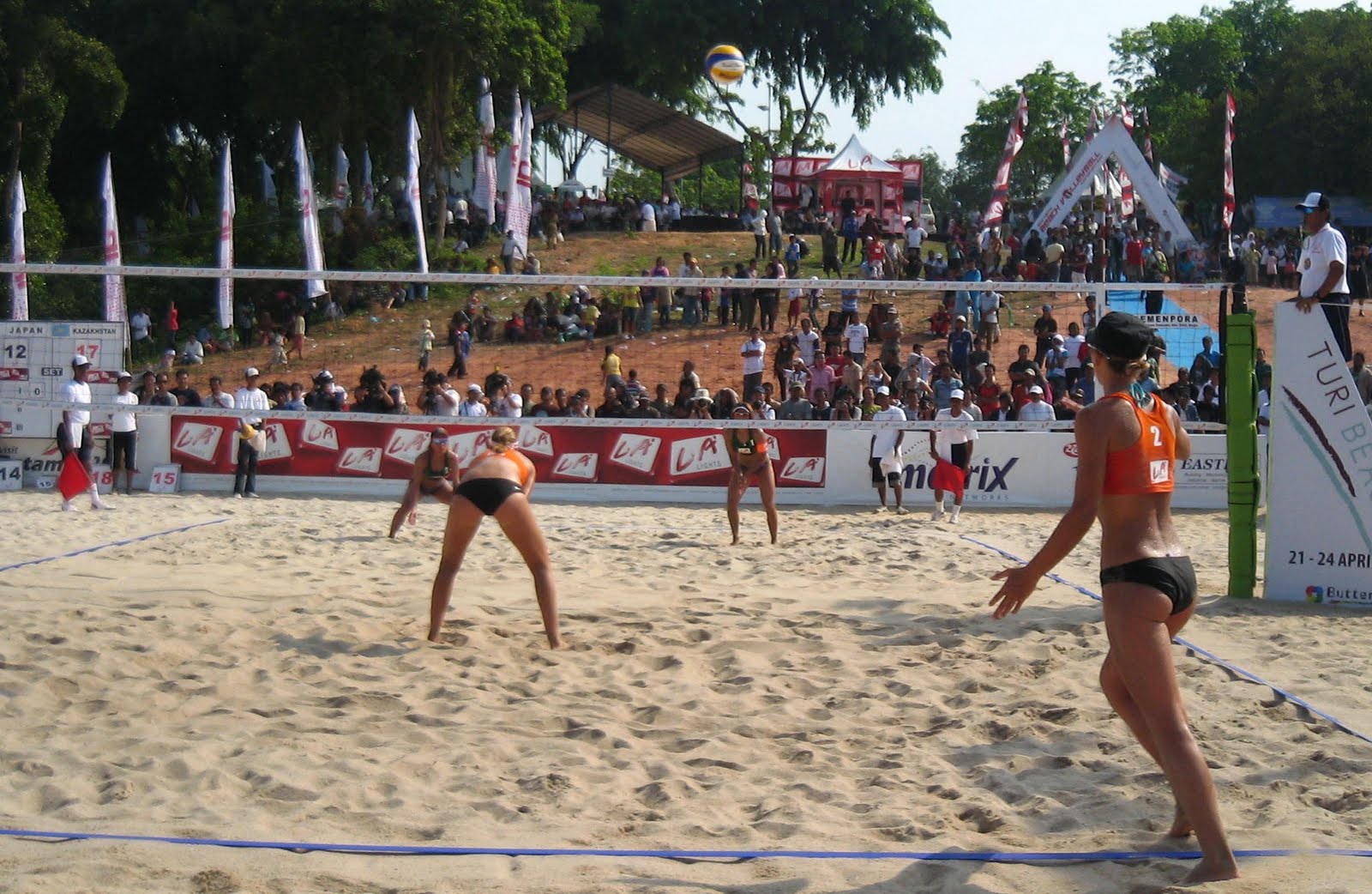
Indonesian men’s pair Koko Prasetyo and Andy Ardiyansah came back from one-set down to beat Reza Assari Naeni and Rahman Raoufi of Iran in the rain-affected final on Saturday to win the trophy at the inaugural Asia-Pacific Beach Volley Ball Tournament in Batam. In the first set, Koko and Andy had little to offer and surrendered 14-21, but started to find form at the beginning of the second set to lead 9-5 before rain temporarily stopped the match. The Indonesian duo maintained the high tempo when the game resumed 10 minutes later and capped the set 21-8. Using the momentum, Koko and Andy led in the third set from the start to complete a comeback and win the set 21-15. “In the first set, we tried normal serves, but it seemed like they had no difficulty receiving. Then we decided to use jump serves and it held back their attacks, helping us gain crucial points. From that point on, we knew their defense was the weak spot,” Koko said after the match. Andy said that they had faced the Iranian pair several times before, and that they had improved a lot. “Iran has at least three good teams and this is one of them.” Although Koko and Andy admitted that while the rain played a part in their win, it was their more aggressive strategy that helped seal victory. “The rain interruption allowed us to regain our strength, but without the change in strategy, the rain would not have helped,” Andy said. The pair picked up US$3,000 in prize money while the Iran duo bagged $2,250. “Andy and Koko are good all-round. We tried our best with our spikes and serves, but most of the time they managed to answer,” Reza said. He added that the rain was not unexpected and had little effect on the match. “In beach volleyball, we have to be prepared for rain. It’s different if you play indoors,” he said. Koko and Andy advanced to the final after defeating Rafi Asruki Bin Nordin and Khoo Chong Long of Malaysia 21-18, 21-15 in the semifinals earlier in the day, while the Irans ousted New Zealand siblings Sam and Ben O’Dea 21-18, 21-18 in the other semifinal. In the battle for third, the O’Deas defeated the Malaysians 21-15, 21-18. In the women’s division, Indonesians Ayu Cahyaningsiam and Efa Sri Susilowati were stopped by Irina Tsimbalova and Mashakova Tatyana of Kazakhstan. The visitors needed only 40 minutes to book a place in the final with an emphatic 21-16, 21-16 beatdown. Later in the day, Ayu and Efa also lost to Julalak Radarong and Meneerat Udomcahvee of Thailand in the match for third place. “We are grateful that we reached the semifinals. The Thais are quite good because they focus on beach volleyball, while Efa and I play professionally in the Proliga [Indonesia’s indoor volleyball league],” Ayu told The Jakarta Post. With their fourth-place finish, Ayu and Efa took home $1350. In the women’s final, the Kazakhs stole victory from a Japanese duo. “We are very happy. This is our first win in an international tournament. We started playing as a pair this year and have participated in four international tournaments and this is our best result,” 22-year-old Mashakova said. They take home $3,000 in prize money. Sam O’Dea and Tsimbalova were also chosen as the best players of the tournament.